
The services sector growth in India rose to a three-month high in December supported by favourable economic conditions and positive demand trends, a monthly survey said on Friday. The seasonally adjusted HSBC India Services PMI Business Activity Index rose from 56.9 in November to 59 in December, highlighting a sharp increase in output that was the most pronounced since September. In Purchasing Managers' Index (PMI) parlance, a print above 50 means expansion while a score below 50 denotes contraction.
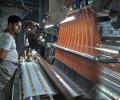
India's manufacturing sector growth climbed to a five-month high in February amid a sharper uptick in factory production and sales, supported by both domestic and external demand, a monthly survey said on Friday. The seasonally adjusted HSBC India Manufacturing Purchasing Managers' Index (PMI) rose from 56.5 in January to 56.9 in February, pointing to the strongest improvement in the health of the sector since September 2023. In Purchasing Managers' Index (PMI) parlance, a print above 50 means expansion while a score below 50 denotes contraction.

Manufacturing activities in India gained momentum in August as new orders and output increased at the quickest rates in nearly three years, according to a survey released on Friday. The seasonally adjusted S&P Global India Manufacturing Purchasing Managers' Index (PMI) rose to 58.6 in August from 57.7 in July. Pollyanna De Lima, Economics Associate Director at S&P Global Market Intelligence, said the PMI results for India painted a vibrant picture of the nation's manufacturing landscape in August.

The HSBC India Manufacturing Purchasing Managers' Index, a measure of factory production, stood at 51.3 in April, unchanged from 51.3 in March, amid moderate expansion of incoming new business orders.

The seasonally adjusted S&P Global India Manufacturing Purchasing Managers' Index (PMI) slipped from 57.5 in September to 55.5 in October, the slowest rate of expansion since February. The October PMI data pointed to an improvement in overall operating conditions for the 28th straight month.

The mismatch between PMI and core sector could also be due to the fact that while core sector is calculated year-on-year, PMI is calculated month-on-month.
Besides, the private sector employment activity also increased for eleventh month running, it said.

Macroeconomic data announcements, global trends and trading activity of foreign investors would guide momentum in the equity market this week, analysts said. Markets ended a five-week losing streak and gained nearly a per cent last week, helped by a sharp rebound on Friday. Last week, the BSE benchmark jumped 500.65 points or 0.77 per cent and the Nifty gained 169.5 points or 0.87 per cent.
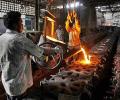
India's manufacturing sector activity was largely flat in April, as rates of growth for new orders and output eased to eight-month lows amid the intensification of the COVID-19 crisis, a monthly survey said on Monday. The seasonally adjusted IHS Markit India Manufacturing Purchasing Managers' Index (PMI) was at 55.5 in April, little changed from March's reading of 55.4. In PMI parlance, a print above 50 means expansion while a score below 50 denotes contraction.

Manufacturing activities in India fell to a five-month low in September as new orders rose at a softer pace, which tempered production growth, a monthly survey said on Tuesday. The seasonally adjusted S&P Global India Manufacturing Purchasing Managers' Index (PMI) fell to 57.5 in September, down from 58.6 in August -- the lowest in five months. The September PMI data pointed to an improvement in overall operating conditions for the 27th straight month.

The Nikkei India Services Purchasing Managers' Index, which tracks the services sector firms on a monthly basis, stood at 50.3 in February, up from 48.7 registered in January.

A reading above 50 denotes expansion while one below means contraction.

Among the Sensex firms, JSW Steel, Tata Steel, Tech Mahindra, Infosys, Wipro, Tata Consultancy Services, Nestle, HCL Technologies, HDFC Bank and Maruti were the major laggards. IndusInd Bank, ITC, Bharti Airtel and State Bank of India were among the winners.
Manufacturing sector activities in India moderated for the second straight month in July as rates of expansion in output and new orders eased slightly, a monthly survey said on Tuesday. The seasonally adjusted S&P Global India Manufacturing Purchasing Managers' Index (PMI) eased to 57.7 in July from 57.8 in June. Despite the fall, the Indian manufacturing sector maintained strong growth momentum at the start of the third quarter amid ongoing buoyant demand, the survey said.
Manufacturing activities in India advanced further and touched a 31-month high in May supported by stronger increase in new orders and favourable market conditions, which in turn generated more employment opportunities, a monthly survey said on Thursday. The seasonally adjusted S&P Global India Manufacturing Purchasing Managers' Index (PMI) rose from 57.2 in April to 58.7 in May, indicating the strongest improvement in the health of the sector since October 2020. The May PMI data pointed to an improvement in overall operating conditions for the 23rd straight month.

The services sector growth in India fell to a one-year low in November on softer expansions in new work intakes and output, despite receding price pressures, a monthly survey said on Tuesday. The seasonally adjusted S&P Global India Services Business Activity Index fell from 58.4 in October to a one-year low of 56.9 in November. Despite witnessing a month-on-month decline, the rate of expansion was stronger than its long-run average.

For the second straight week, the Sensex rose, notching up a significant gain of 528.34 points, or 1.59 per cent. The Nifty was up 129.45 points, or 1.25 per cent, during the week.

Investors engaged in profit booking in the recent gainers at attractive and higher valuations.
Manufacturing activities in India accelerated further and touched a four-month high in April, boosted by robust new business growth, mild price pressures, better international sales, and improving supply-chain conditions, a monthly survey said on Monday. The seasonally adjusted S&P Global India Manufacturing Purchasing Managers' Index (PMI) increased from 56.4 in March to 57.2 in April, indicating the fastest improvement in the health of the sector so far this year. The March PMI data pointed to an improvement in overall operating conditions for the 22nd straight month.

The Reserve Bank of India's interest rate decision, macroeconomic data and global trends will drive investors' sentiment this week, with markets hoping to continue the positive momentum after ending FY24 on a buoyant note, analysts said. In addition, the trading activity of foreign investors, the rupee-dollar trend and the movement of global oil benchmark Brent crude would also influence trading in equity markets. The 30-share BSE Sensex climbed 14,659.83 points or 24.85 per cent in the 2023-24.

Manufacturing sector activities in India moderated in June from a 31-month high in May, but output remained in the growth territory, as new work orders expanded sharply amid favourable demand conditions, a monthly survey said on Monday. The seasonally adjusted S&P Global India Manufacturing Purchasing Managers' Index (PMI) fell from 58.7 in May to 57.8 in June. Despite the fall, the headline figure pointed to a considerable improvement in operating conditions, the survey said, adding that the demand strength positively impacted several other measures such as sales, production, stock building and employment.

On the price front, Indian manufacturing companies continued to face higher input costs during August.

India's services sector activity eased in August but growth rates for new orders remain elevated, as services firms indicated the sharpest upturn in new export business which acted as a catalyst for firms to expand their workforces as well as output, a monthly survey said on Tuesday. Despite falling from 62.3 in July to 60.1 in August, the seasonally adjusted S&P Global India Services PMI Business Activity Index indicated one of the strongest increases in output seen since mid-2010. For the 25th straight month, the headline figure was above the neutral 50 threshold.
The growth momentum in India's manufacturing sector was maintained in February, with new orders and output increasing at similar rates to January, according to a monthly survey. The seasonally adjusted S&P Global India Manufacturing Purchasing Managers' Index (PMI) was at 55.3 in February, little-changed from 55.4 in January. The February PMI data pointed to an improvement in overall operating conditions for the 20th straight month. In PMI parlance, a print above 50 means expansion while a score below 50 indicates contraction.

On price rise, HSBC said that the rate of cost inflation decelerated sharply while output prices were unchanged.

From the Sensex basket, Kotak Mahindra Bank, HCL Technologies, ICICI Bank, Infosys, Tata Consultancy Services, Wipro, Tech Mahindra and Larsen & Toubro were the major laggards. Mahindra & Mahindra, Nestle, Tata Motors and IndusInd Bank were among the gainers.

India's manufacturing sector activity moderated in January amid slower increase in total sales, and headcounts were broadly unchanged amid sufficient staff numbers to cope with current requirements, according to a monthly survey. The seasonally adjusted S&P Global India Manufacturing Purchasing Managers' Index (PMI) fell from December's recent high of 57.8 to 55.4 in January, as factory orders and production rose at sharp, albeit slower, rate. The January PMI data pointed to an improvement in overall operating conditions for the 19th straight month.

The index has posted below the 50 mark, which marks contraction, for the third consecutive month.
India's manufacturing sector continued with its robust performance in November, mainly on the back of substantial easing in price pressures and strengthening demand from clients, a monthly survey said on Friday. The strong performance of the manufacturing sector is expected to continue in 2024 as well. The seasonally adjusted S&P Global India Manufacturing Purchasing Managers' Index (PMI) rose to 56 last month from the eight-month low level of 55.5 recorded in October.

Among the Sensex firms, Asian Paints, Tata Steel, HCL Technologies, Nestle, Maruti, JSW Steel, NTPC and Larsen & Toubro were the major laggards. Sun Pharma, Bajaj Finserv, Reliance Industries, State Bank of India and Bharti Airtel were the gainers.
Manufacturing activities in India touched a three-month high in November as new orders and exports expanded boosted by demand resilience and substantial easing of cost pressure, according to a monthly survey released on Thursday. The seasonally adjusted S&P Global India Manufacturing Purchasing Managers' Index (PMI) stood at 55.7 in November, up from 55.3 in October, signalling the strongest improvement in operating conditions in three months. The November PMI data pointed to an improvement in overall operating conditions for the 17th straight month.
RBI's interest rate decision, macroeconomic data, global trends and trading activity of foreign investors are the crucial factors to drive equity markets in a holiday-shortened week ahead, analysts said. Markets would remain closed on Monday for Gandhi Jayanti. "While global cues will continue to dictate trends in local markets, focus will shift to RBI's monetary policy announcement on Friday. "Although the market is expecting a status quo on interest rates, global concerns like rising US dollar index and bond yields coupled with surging crude oil prices continue to weigh on investors' minds.
Manufacturing activities in India touched a three-month high in March boosted by faster expansions in new orders and output amid demand resilience and easing of cost pressures, according to a monthly survey. The seasonally adjusted S&P Global India Manufacturing Purchasing Managers' Index (PMI) rose from 55.3 in February to 56.4 in March, signalling the strongest improvement in operating conditions in 2023 so far. The March PMI data pointed to an improvement in overall operating conditions for the 21st straight month.

The Indian services sector expanded at the strongest rate in 12 years in February supported by favourable demand conditions and new business gains, a monthly survey said on Friday. The seasonally adjusted S&P Global India Services PMI Business Activity Index rose from 57.2 in January to 59.4 in February -- its highest level in 12 years. For the 19th straight month, the headline figure was above the neutral 50 threshold. In Purchasing Managers' Index (PMI) parlance, a print above 50 means expansion while a score below 50 denotes contraction.

Manufacturing activities in India eased marginally in September but remained in good shape amid companies hiring more workers and cooling price pressures, according to a monthly survey released on Monday. The seasonally adjusted S&P Global India Manufacturing Purchasing Managers' Index (PMI) indicated a strong improvement in the health of the Indian manufacturing industry, as companies stepped up production in tandem with a sustained increase in new work intakes. The PMI at 55.1 in September continued to be in expansion mode for the 15th consecutive month but was slightly lower than 56.2 recorded in August.
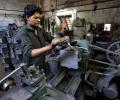
India's manufacturing sector activity rose to a 13-month high in December, supported by healthy inflows of new business and strong demand conditions, according to a monthly survey. The seasonally adjusted S&P Global India Manufacturing Purchasing Managers' Index (PMI) stood at 57.8 in December, up from 55.7 in November, as business conditions improved to the greatest extent in over two years. The December PMI data pointed to an improvement in overall operating conditions for the 18th straight month.

Index heavyweights continue to be top losers with ICICI bank.

India's services sector growth accelerated in April, as strong demand conditions resulted in the fastest increase in new business and output in close to 13 years, a monthly survey said on Wednesday. The pick-up in demand occurred in spite of escalating price pressures. The seasonally adjusted S&P Global India Services PMI Business Activity Index rose from 57.8 in March to 62.0 in April, signalling the fastest expansion in output since mid 2010, amid a pick-up in new business growth and favourable market conditions.
Manufacturing activities in India remained robust and price pressures were contained in October as new orders and production rose at a slower but stronger pace, according to a monthly survey released on Tuesday. The seasonally-adjusted S&P Global India Manufacturing Purchasing Managers' Index (PMI) was up from 55.1 in September to 55.3 in October. The October PMI data pointed to an improvement in overall operating conditions for the 16th straight month.
India's manufacturing sector activities witnessed faster growth in April amid quicker increases in production as well as factory orders, and renewed expansion in international sales, a monthly survey said on Monday. The seasonally adjusted S&P Global India Manufacturing Purchasing Managers' Index (PMI) rose from 54.0 in March to 54.7 in April, as a retreat of COVID-19 restrictions continued to support demand. The April PMI data pointed to an improvement in overall operating conditions for the tenth straight month. In PMI parlance, a print above 50 means expansion, while a score below 50 denotes contraction.
